
FuelPass — Airline Fuel Procurement, Simplified
FuelPass is an MVP desktop platform that brings clarity to aviation fuel procurement—helping airline teams make faster, cost-aware decisions without relying on fragmented tools.
My Role
UX Designer (2-Designer Team) — co-led design efforts from discovery to final delivery.
Collaborated on stakeholder and PM requirements; created and validated low-fidelity before high-fidelity. Owned and evolved the design system, led high-fidelity UX, and supported frontend delivery.
Approach
Structured a fragmented workflow into a validated, scalable product through early alignment, iterative prototyping, and system-driven design.
Stakeholder Collaboration
Stakeholders acted as domain experts and primary airline users—shaping workflows, validating designs early, and ensuring alignment with real procurement operations.

Fuel procurement inefficiencies stemmed from poor structure and visibility—leaving airline teams chasing information instead of making confident decisions.
KEY INSIGHT
01 — THE PROBLEM
Fragmented Airline Fuel Procurement
Airline fuel procurement was managed across emails, calls, and spreadsheets, creating fragmented workflows and limited visibility. Teams could not easily compare suppliers, track request status, or manage responsibilities in one place—leading to delays, errors, and constant follow-ups.
Key Observation
-
No single source of truth — data spread across channels
-
Inefficient supplier comparison — no unified pricing view
-
Poor status visibility — users chased updates
-
Unclear roles — caused delays and confusion
-
High manual effort — increased error risk
-
Timezone issues — disrupted coordination
The Goal
Centralize airline fuel procurement into a structured, role-based system that improves visibility, reduces manual effort, and enables faster, confident decision-making.
02 — Discovery & Problem Framing
Bringing Structure to Airline Fuel Procurement
Initial discussions and workflow mapping revealed consistent friction in how airline teams managed fuel procurement. The issue wasn’t lack of data—it was how fragmented and inaccessible that data was during decision-making.
Given multiple stakeholders and time constraints, a lean discovery approach was used to quickly align on workflows and identify breakdowns.
Direction & Constraints
Stakeholders set a clear expectation:
-
Procurement workflows spread across emails, calls, and spreadsheets
-
No centralized system or real-time visibility
-
Multiple roles with unclear ownership and handoffs
-
Solution needed to be simple, scalable, and role-aware
This reframed the challenge from managing tasks to structuring a unified procurement experience.
Signals & Insights
-
Information existed but was not accessible in one place
-
Supplier comparison lacked a clear, unified view
-
Request status tracking was manual and inconsistent
-
Heavy reliance on follow-ups and coordination
These patterns indicated a system-level inefficiency, not isolated usability issues.
Hypothesis & Opportunity
Based on available inputs, key hypotheses emerged:
-
Delays were caused by lack of visibility, not lack of data
-
Fragmented workflows increased decision time and cognitive load
-
Absence of structured workflows led to errors and inefficiencies
This revealed a clear opportunity:
Shift from fragmented, communication-driven processes to a centralized, system-driven procurement platform for airline teams.
Key Takeaways
Direction & Constraints
The problem was rooted in fragmentation and lack of structure, requiring a system-level solution rather than incremental fixes.
Signals & Insights
Scattered information and poor visibility slowed decisions and increased manual effort.
Hypothesis & Opportunity
Airline teams needed clarity and structured workflows to make faster, more confident procurement decisions.
03 — Design Solution
From Fragmented Processes to a Structured Procurement Platform
The experience was redesigned from scattered, communication-driven workflows into a centralized, system-led platform for airline fuel procurement. Instead of relying on emails and manual coordination, the system now guides users through clear, structured steps—from setup to decision-making.
At this stage, low-fidelity wireframes were created and validated to establish flow and structure, followed by high-fidelity screens to finalize interaction and visual direction.

Key Screens (High-Fidelity)
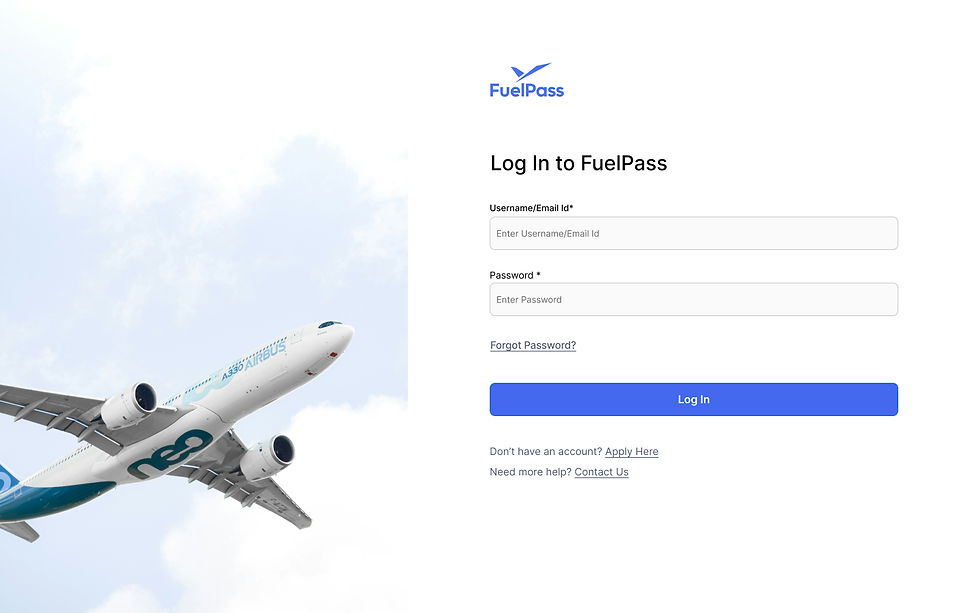
1. Login & Access
-
Secure entry point with role-based access
-
Directs users to the relevant airline dashboard
2. Dashboard (Setup & Overview)
-
Central hub to manage procurement readiness
-
Upload mandatory documents (e.g., airline registration, tax documents)
-
Quick visibility into system status and next actions

3. Team Management
-
Invite and manage airline team members
-
Define roles and responsibilities for procurement workflows
.jpg)
4. Fuel Price Visibility
-
View and compare fuel prices from suppliers
-
Centralized data for faster, informed decisions

5. Create First Order
-
Structured flow to initiate fuel procurement
-
Capture all required details in one place
.jpg)
Key Design Decisions
-
Shifted from communication-heavy workflows → system-driven platform
-
Introduced step-by-step structure instead of unorganized task handling
-
Centralized data, roles, and actions into a single interface
-
Validated flows early through wireframes before high-fidelity execution
-
Built on a scalable design system that evolved with the product
04 — Testing & Validation
Validated through stakeholder reviews + AI evaluation
As this was an MVP desktop platform, testing was conducted with stakeholders who also represented the primary airline users. End users were not involved at this stage. The focus was to validate workflows, usability, and feasibility before development.
Stakeholder Review
High-fidelity Figma designs were reviewed with stakeholders to ensure alignment with real procurement processes.
-
Strong alignment on centralizing procurement into a single platform
-
Positive feedback on supplier comparison improving decision speed
-
Validation of role-based visibility reducing confusion
-
Consensus that the flow reduces manual coordination and follow-ups
-
Confirmed feasibility and alignment with operational needs
Outcome
Stakeholder validation provided confidence that the solution is practical, aligned with business workflows, and ready for implementation. The MVP establishes a strong foundation, with end-user testing planned for future iterations
05 — The Design System
Built for Consistency, Scalability, and Data-Heavy Workflows
A scalable design system was created to ensure consistency across the airline procurement platform and support rapid iteration as the product evolved.

COMPONENTS
-
Forms & Input Fields — structured data entry for fuel requests
-
Tables & Data Views — supplier comparison, pricing, and request tracking
-
Buttons & Actions — primary, secondary, and state-based interactions
-
Dropdowns & Selectors — supplier selection, roles, and filters
-
Tabs & Navigation — organizing dashboard sections and workflows
-
Cards & Panels — grouping key information and actions across screens
Foundations
-
Typography — clear hierarchy for data-heavy interfaces
-
Color System — consistent usage for actions, states, and status indicators
-
Spacing & Layout Grid — aligned structure for readability and scalability
Why it Matters
-
Ensures visual and interaction consistency across all pages
-
Speeds up design and development through reusable components
-
Supports scalability as new features and workflows are added
-
Improves usability in complex, data-driven environments
06 — Result & Impact
6–8 weeks
From fragmented workflows to a unified procurement platform
5+ core tasks
Simplified core airline procurement tasks into clear, guided flows
2–3 iterations
Refined through continuous stakeholder feedback
40% less manual effort
Reduced dependency on emails, calls, and spreadsheets
Established a Structured Foundation for Fuel Procurement
As an MVP desktop platform built for a client requirement, the focus was on validating a clear, scalable approach to airline fuel procurement.
Outcome
Stakeholder Feedback
“Centralizing everything has made the process much clearer. This MVP gives us a solid foundation to take it to market, test it with real users, and scale it further.”
6–8 weeks
From fragmented workflows to a unified procurement platform
5+ key workflows
Simplified core airline procurement tasks into clear, guided flows
2–3 iterations
Refined through continuous stakeholder feedback
40% less manual effort
Reduced dependency on emails, calls, and spreadsheets